
Our story
Duncan Hill’s story begins with a single Bedford dropside in post-war Cumberland and runs through the Marchon years and the London runs to the chemical specialism that defines the business today.
It’s the story of a family business that’s been through several eras of British haulage and still recognisably the same operation at the end of it. Most of the photographs are missing, but the route is clear enough.
1925
Duncan Hill is born in Dearham, Cumberland.
Duncan was born in the West Cumberland village of Dearham.
After wartime military service he set up as a plasterer, buying a Bedford Type ‘O’ dropside flatbed from Pattinson’s Flour Mills of Whitehaven to cart his sand and materials.
1951
Duncan sets up as a haulage contractor.
After wartime military service and a stint as a plasterer, Duncan buys a Bedford Type ‘O’ dropside flatbed from Pattinson’s Flour Mills of Whitehaven, originally to cart plastering sand.
When road transport is de-nationalised in 1951, he moves out of the building trade and into haulage full-time, working for local firms, mainly in agriculture.
1960’s
The Marchon years begin.
Duncan becomes the first independent haulage contractor to work for Marchon Products at Whitehaven, the giant detergent and phosphates producer owned by Albright and Wilson, which had previously used only its own in-house transport.
It’s the break the business needs.
1960’s & 1980’s
London becomes Duncan Hill’s patch
Throughout the 1970s and ’80s the firm transports washing powder from Whitehaven to supermarket regional distribution centres across the south east.
Few London hauliers want to come all the way up to Cumbria for return work, so Duncan secures plenty of regular backloads. The fleet grows to six artics and a similar number of owner-drivers running sub-contract work.
1984
Duncan Hill becomes a limited company.
After more than thirty years of trading, the business is formally incorporated.
1990
A change of ownership.
Duncan announces his retirement. Edward “Ned” Nixon, a dairy farmer from Camerton near Workington who’d known Duncan socially and worked with him on sawdust and wood shavings backloads from Essex, sees the opportunity to expand his interests and buys the business as a going concern.
The Nixon family has owned it ever since.
1990s & 2000s
Into chemicals
The business moves steadily towards specialist bulk liquid haulage, building the expertise, accreditations and relationships that now define the operation.
In May 2018, The ATF lane opens. A new DVSA / VOSA-approved Authorised Testing Facility opens at Crosby Villa, just off the A596 near Maryport, suitable for HGVs, trailers and PSVs of any make.
Today
Where Duncan Hill is at
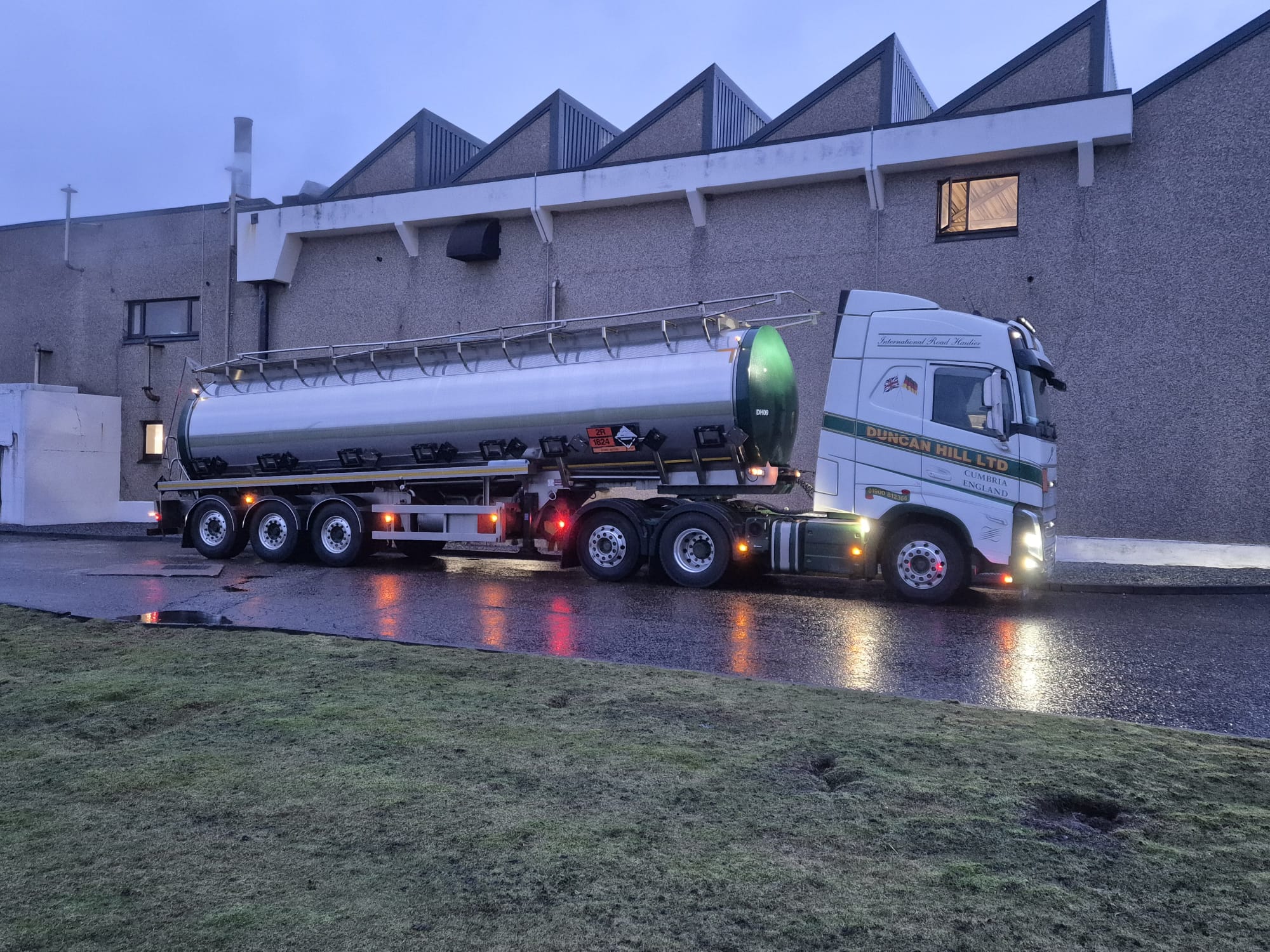
A specialist bulk liquid hauler running road and rail tanker work, an ATF testing lane, tank cleaning, tank hire and warehouse storage from one Cumbrian yard.
HCDG approved. ADR qualified throughout. Still family-run.
what we do
Explore our full range of services.
Everything we offer, from road and rail tanker work to testing, cleaning and storage.